PPC managers, are you familiar with the following? Star employees disengaging. High turnover. Overworked staff who are disconnected from their work and make mistakes you simply can’t understand. Well, there’s a reason for the lack of engagement and seemingly poor attention to detail.
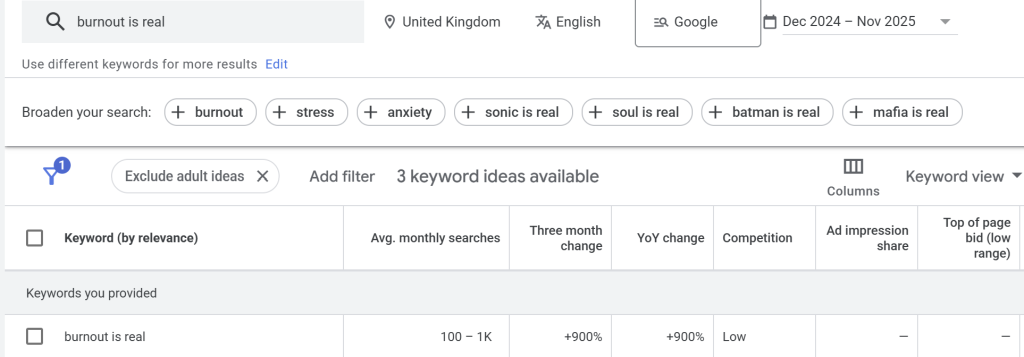
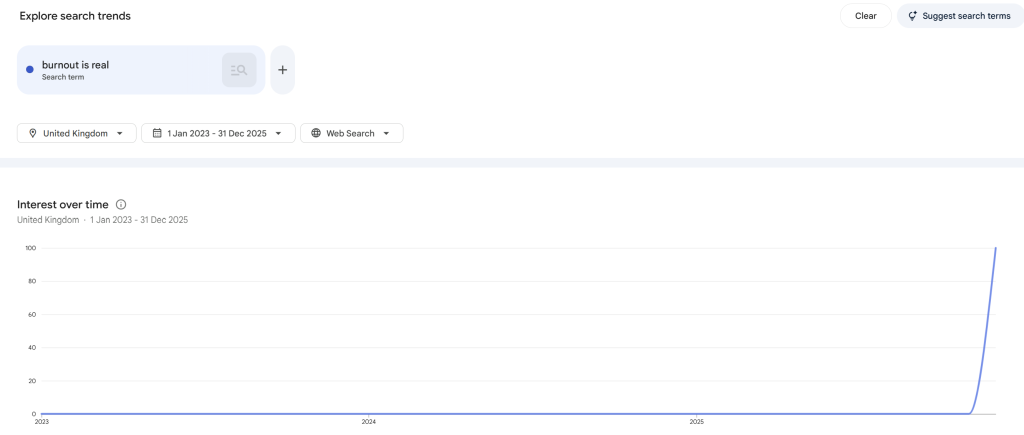
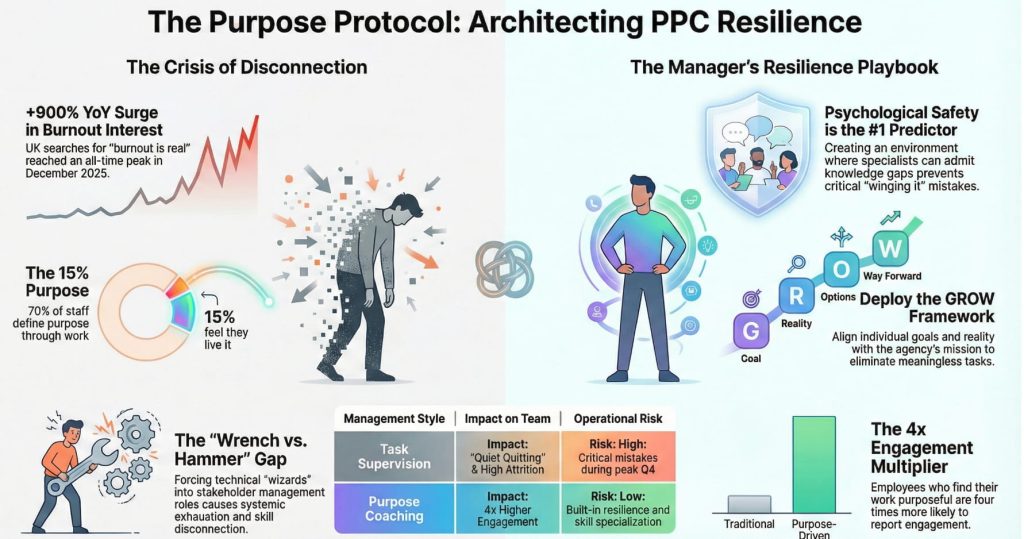
In 2023, the industry was obsessed with “Quiet Quitting”. But as we enter 2026, the data shows a much more dangerous evolution. As seen in the images below, UK search interest for the specific phrase “burnout is real” has surged by +900% Year-over-Year, reaching its all-time peak in December 2025. This search trend reflects a deeper structural decay: while 70% of employees define their sense of purpose through their work, only 15% of frontline staff (those below executive or upper management level) actually feel they are living it (McKinsey, 2021). Our teams aren’t just doing the bare minimum anymore; they are hitting a wall of total systemic exhaustion precisely when our clients need them to be most alert (Q4).
TLDR
The “Wrench vs. Hammer” Cognitive Gap
So, what exactly is the problem? Well, we treat junior members of PPC teams like Swiss Army Knives, expecting people to get stuck in and be jacks of all trades. However, when we do this, we force a Wrench (a technical wizard) to spend its day acting like a Hammer (a charismatic stakeholder manager), pulling people further away from their own skillsets and interests, creating a disconnect between the job and that sense of purpose that makes people go to great lengths to deliver excellent work.
The rise in burnout means it’s no longer enough to manage reports with a blanket approach. Instead, empathy and resilience are the new career currency. This is because when an employee is expected to do it all and isn’t encouraged to specialise, they don’t develop confidence in their skills. This sounds inconsequential, but it’s more important than managers realise. Clients rely on agencies and PPC professionals and the quality of the work, the attention to detail from staff, and the output depends heavily on how invested people are in their jobs and, without purpose, people simply don’t have the mental bandwidth to deliver the best quality work.
The Science: Why “Safety” is a Financial Metric
Google’s Project Aristotle found that the #1 predictor of team success was Psychological Safety. This isn’t just “being nice.” It’s a strategic framework where managers act as enablers and coaches, not task supervisors. In an agency, safety is built through leverage. By understanding what your reports are good at and allowing them to specialise, you give them confidence in their skills. When they’re confident, it’s easier for them to admit that they don’t understand certain concepts. Without feeling competent, admitting you don’t understand something feels like admitting you’re “not enough”.
Trust me when I say, the last thing any manager wants when working in PPC with data, algorithms, and delicate account structures is a team that ‘wings it’ and holds questions back because they’re afraid of looking incompetent. It’ll cost you time, effort, and (potentially) the client if critical mistakes are made. When a manager helps an employee find their Pillar (their “Anchor”), you remove the interpersonal risk of failure.
The Manager’s Playbook: Building Resilience Architecture
I’ve spoken about what the issue is and why it matters. But, there’s no point sounding the alarm without giving practical tips. So, I want to ground my article with some practical advice you can take and follow in your next 1-1. To stop burnout in its tracks, managers must get to know their reports as people rather than “human resources”. I’ve pulled together some tips from Lancer et al. (a workplace coaching specialist) to ensure managers understand how to work with their reports to find out how to inject purpose into their day to day.
- Create A Social Foundation: Before talking KPIs, you must understand the human. Identify their characteristics, current strengths, and future aspirations. For example, I’m into all things technical and my manager knew this, so she let me get involved in creating dashboards and scripts. It turned what could have been a flat and draining job into a creative one.
- Leverage The Tools At Your Disposal: Assess the tools and systems you have access to. If your employee is into creative writing, can you give them access to funded or free copywriting courses? If they’re a whizz at creating processes, can you guard their time to ensure they do less admin and button pushing, and spend more time auditing processes and creating new ones? The key is to see how you can enable your team.
- The Strategic Bridge: Use the GROW framework (Goals, Reality, Options, Will) to align individual purpose with the agency’s mission. This eliminates the “hollow” feeling of meaningless tasks by showing the employee exactly where they add value. For instance, my team needed some broken dashboards fixed to monitor search impression share and keep an eye on competitors. Being told verbally that the work I did would help us monitor our impression share and help with reporting dialled my passion for the project up to 10. The truth is, helping employees feel connected to the business isn’t just ‘soft’ management; it’s a performance multiplier. Using GROW to nurture future strengths is the ultimate retention tool. Employees who find their work purposeful exhibit more resilience and are 4x more likely to report higher engagement (McKinsey, 2020).
- Synthesised Coaching: Coach the team together. When everyone knows each other’s strengths, the team can naturally compensate for weaknesses, reducing individual anxiety and collective friction. Personally, knowing there’s a dedicated Shopping or PMax expert on the team means I feel free to create and develop all of the dashboards, scripts, and processes that my team desires.
Conclusion: The Long-Term Win
The current way of working isn’t effective. With searches for burnout increasing YoY and people experiencing increased hunger for purpose, managers cannot afford to ignore purpose. It’s not a “nice to have”. It’s essential. If you don’t ensure that staff feel confident, competent, and connected to their work, you’re opening the floodgates for negative outcomes. Staff will “quiet quit” or quit outright, leaving the rest of the team spread thin while HR scrambles to find new staff. Attrition in agencies is so common that the industry treats it as the norm, not realising that failure to retain staff hurts team morale and the quality of the work.
Moreover, since burnout is the worst during December, teams don’t have the mental bandwidth to produce quality work during the time that clients need it the most (Cyber through to Christmas). This runs the risk of making costly mistakes (e.g., setting incorrect budgets or activating the wrong ads) and disappointing or losing the client. Success in 2026 won’t go to the agency that grinds its people the hardest; it will go to the one that builds the most structurally sound human environment.
If you want solid, consistent teams that care about their work, stop managing your people like line items. Build a toolkit where every “Wrench” and “Hammer” knows exactly where they fit. The short-term cost is your mental energy; the long-term win is a team that actually wants to win for you.