
If you’re running B2B Google Ads campaigns and not seeing the lead quality or volume you’d hoped for, your keyword strategy might be holding you back. The difference between a campaign that drains your budget and one that delivers qualified leads often comes down to how well you’ve optimised for B2B-specific keywords.
Let’s break down why focusing on high-intent keywords and long-tail phrases can transform your lead generation results whilst making your budget work harder.
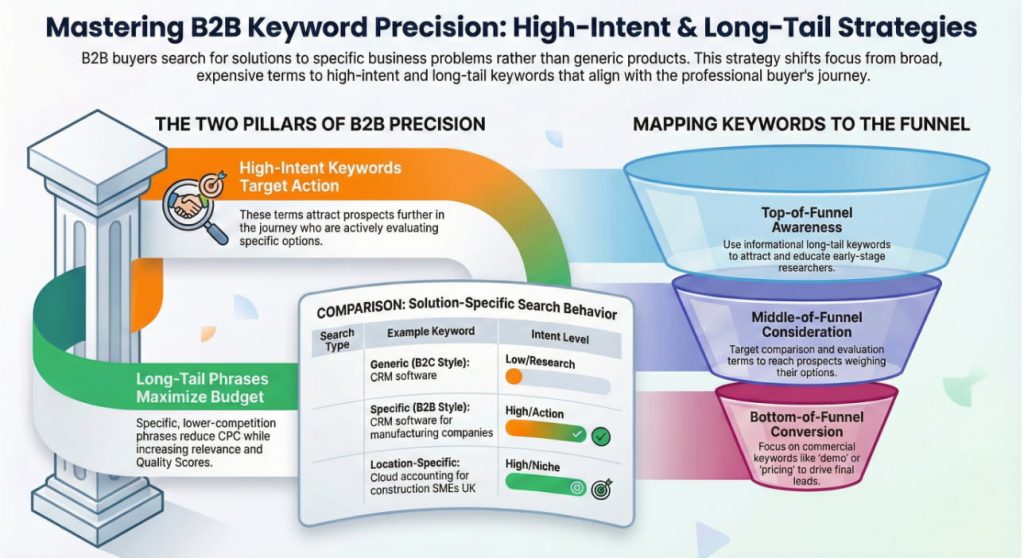
Understanding B2B Search Behaviour
B2B buyers search differently than consumers. They’re looking for solutions to specific business problems. A consumer might search for “email software,” but a B2B decision-maker searches for “enterprise email marketing platform for SaaS companies. This difference is crucial because it affects everything from your keyword selection to your CPC and, ultimately, your lead quality.
The Power of High-Intent Keywords
High-intent keywords are search terms that indicate someone is ready to take action. In B2B, these often include phrases like:
- “Best [solution] for [industry]”
- “[Service] provider UK”
When someone searches using these terms, they’re not just browsing, they’re actively evaluating options. Whilst these keywords might have a higher CPC, they’re worth the investment because they attract prospects who are further along in the buying journey. A lead from someone searching “CRM software for manufacturing companies” is far more valuable than one from a generic “CRM” search.
The key is identifying which high-intent keywords align with your ideal customer profile. These searches might cost more per click, but they convert at higher rates, making your overall cost-per-lead more efficient.
Why Long-Tail Keywords Are Your Budget’s Best Friend
Long-tail keywords are longer, more specific search phrases that typically have lower search volumes and lower competition. Instead of targeting “accounting software” (expensive and generic), you’d target “cloud accounting software for construction SMEs UK.”
Here’s why long-tail keywords work brilliantly for B2B:
- Lower CPC means your budget stretches further
- Higher relevance equals better Quality Scores
- Less competition from larger competitors
- More qualified traffic
Building Your B2B Keyword Strategy
Start by mapping out the customer journey. What questions do prospects ask at each stage? What problems are they trying to solve? Use these insights to create keyword lists that match different buying stages.
For top-of-funnel awareness, you might use long-tail informational keywords like “how to improve B2B lead quality”. These attract early-stage researchers and help build your pipeline.
For middle-of-funnel consideration, target comparison and evaluation terms such as “best project management tools for agencies UK”.
For bottom-of-funnel conversion, focus on high-intent commercial keywords like “enterprise CRM demo” or “marketing automation platform pricing.”
Making Your Daily Budget Go Further
The combination of high-intent and long-tail keywords creates a balanced approach. The trick is continuous optimisation. Monitor which keywords are converting, and don’t be afraid to bid more aggressively on the winners whilst pausing underperformers. Your goal is to find the sweet spot within your keyword targeting list.
Why This Matters for Your Lead Targets
Optimising your Google Ads strategy for B2B-specific keywords isn’t just about following best practices, it’s about fundamentally changing how you attract and convert leads.
If you haven’t reviewed your keyword strategy recently, now’s the time. The difference between meeting your lead targets and missing them could be as simple as shifting focus to the keywords that B2B buyers are actually using. Start by auditing your current campaigns. Which keywords are generating leads? Which are just spending money? Then build out more variations of your winners, especially long-tail versions that can stretch your budget whilst maintaining lead quality.