Making the leap from agency life into paid search freelancing is one of the most exciting—and daunting—career moves you can make. You go from being part of a machine with defined roles to becoming the machine itself: salesperson, strategist, account manager, and finance team all in one.
The good news? Many who’ve done it successfully have left a roadmap behind. Below is a distilled guide built around real-world advice from seventeen experienced paid search freelancers who’ve already made the transition.
TLDR
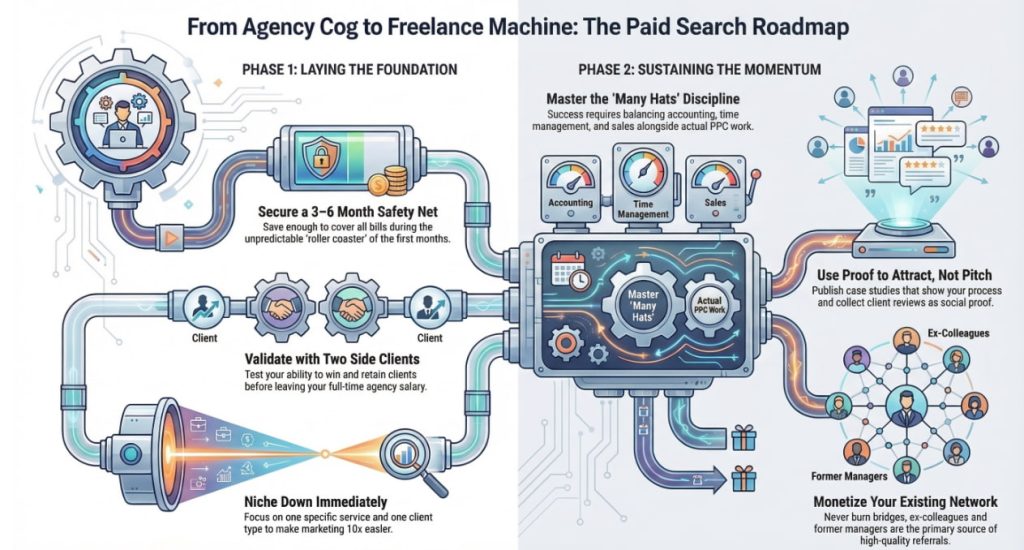
1. Build a Financial Safety Net First
Before anything else, get your finances in order. Freelancing income is rarely immediate or predictable.
Sofia Akritidou puts it plainly:
“Make sure you have enough money saved up that will allow you to live without income for at least 6 months. Going into freelancing, there’s no guarantee that you’ll earn work/clients from the first 1-2 months in.”
This is echoed across the board. Lol Lowe adds a slightly more tongue-in-cheek warning:
“Save 3-6 months income before going freelance so you’ve got a safety net while building up your client base. Or don’t, and let the panic drive you to say yes to every opportunity giving more stress as you work with people that aren’t in your ICP like I did!”
And Meriem Nacer reinforces the reality:
“It’s not easy. Agencies have entire teams handling sales, ops, and delivery, freelancing means you are all of those people. So before you make the jump, plan ahead, have 3 – 6 months of bills covered, because it’s a roller coaster. Build a rainy day fund for the slow patches.”
Dez Calton emphasises the importance of savings:
“Make sure you have some savings behind you whilst things are building and understand that most things will always take longer than you originally think.”
2. Start Before You Quit
One of the biggest mistakes is going “all in” too early without validating your ability to win clients.
Rei Wakayama advises:
“Start by testing the waters while keeping your full-time job. Treat it as a side hustle first. That way, you have a safety net while you invest time in the behind-the-scenes work that doesn’t immediately pay off, like building your website and doing client outreach.”
Filip Šilobod adds a practical layer:
“Have 2 clients on the side for stability and growth. I jumped straight in from an agency and it was very hard fining the first client and keeping them for more than 3 months.”
3. Niche Down Early
Trying to serve everyone is one of the fastest ways to stall your freelance growth.
Pete Bowen explains it clearly:
“Pick one service and one type of client for the first year or so. e.g. Google Ads for immigration consultants, Facebook ads for residential electricians. This makes it 10x easier to market your services and 10x easier to deliver services.”
Amir Gabriel Gomez builds on that:
“Define your target market based on what worked for you, even if it was just 2-3 clients that performed well, you’re already ahead of 80% of freelancers with that, and it’ll be much easier to close business”
And Neil Robinson sums it up with a simple metaphor:
“Better to fish in the right pond than the wrong river”
4. Solve Client Acquisition Before You Need It
In agencies, work comes to you. As a freelancer, it’s your responsibility to create that pipeline.
Dii Pooler highlights this shift:
“My biggest advice is to figure out client acquisition before you go freelance. At an agency, there’s usually a sales team keeping work coming in. On your own, you need to know how you’ll consistently get clients, how you’ll stand out, and how much client work you can realistically handle solo before making the jump.”
LinkedIn can play a major role here. Filip Šilobod notes:
“If you work in a agency, you more likely use Linkedin only when job hunting. No, use it regularly to post, comment, interact with PPC news and connect with business owners or marketing managers.”
5. Use Proof to Attract Clients (Not Cold Outreach)
The strongest freelancers don’t chase clients—they attract them.
Sarah Sal explains her approach:
“Case studies are why I don’t need to cold pitch. Clients come to me. When I write a case study, I don’t just share the results. I show the process. Step by step, how I got there. It almost feels like I’m telling the reader,
“Go ahead. Try to replicate this.”
“And somehow that doesn’t make people run off to do it themselves. Instead, they show up already warm, already sold, and asking how we can work together.”
Hana Kobzová reinforces the importance of social proof:
“My biggest advice: start collecting client reviews as early as possible. If you’re in an agency, you’re already doing the work. But what you often don’t have is proof with your name on it.”
“Ask clients you work closely with to highlight things like:
- how easy you are to work with
- how fast you deliver
- how you communicate and handle problems
“This kind of feedback becomes your biggest asset when you go freelance. You can use these reviews on your website and also on LinkedIn to build credibility.”
“Because at the end of the day, who would you hire: someone with 0 reviews, or someone with 10+ strong ones?”
“And the earlier you start collecting them, the better.”
6. Leverage Your Existing Network
Your first clients are often closer than you think.
Jennifer Mussell shares:
“One of my first gigs as a freelancer came from an ex-client who had gone freelance themselves. They knew I could be trusted to do the job right and they liked worked with me, which is really all you need.”
And Hannah Zora Strong offers a critical reminder:
“Never burn a bridge! It may be tempting to give your boss / colleagues / clients the middle finger as you stroll out the door to your new freelance life – but connections are king!”
“I’ve been self-employed for 4 years now, and the number of ex-clients, ex-colleagues and ex-managers who’ve referred work my way has paid my mortgage 5-fold.”
7. Build a Support System (Freelancing Can Be Lonely)
Agency life is social. Freelancing can be isolating if you’re not intentional.
Heather Robinson advises:
“Find your tribe. Build a network of people you trust and can learn from. They will open doors to opportunities and clients, but just as importantly, they will make freelancing feel far less isolating.”
Meriem Nacer adds:
“Your community is there to remind you. Lean on them when your confidence dips. Let them reflect back what you’re good at and always come back to your why, because that’s what will carry you through the slow patches more than anything else.”
8. Prepare for the Reality of Wearing Every Hat
Freelancing isn’t just doing great PPC work—it’s running a business.
Dez Calton outlines the reality:
“Being disciplined with your time management is essential as working for yourself means you have many different things to do working on your social media presence, website, accounting, networking, invoicing, TX planning, banking, and that all before even touching getting clients, doing the work, reporting etc.”
Chris Kostecki adds an often-overlooked point:
“Respect other business services as much as you expect clients to respect digital marketing. CPAs, bookkeepers, lawyers, insurance agents, and more provide valuable services for businesses, including solopreneurs and can save you from costly mistakes. The relationships can also foster a great network for new business over time.”
9. Discipline Is the Real Differentiator
Without structure, freelancing quickly falls apart.
Amrit Saboo sums it up simply:
“Freelance if you can practice discipline because discipline is freedom”
Final Thoughts
There’s no single path into paid search freelancing—but there is a pattern to success:
- Build financial security
- Start before you quit
- Niche down
- Solve client acquisition early
- Use proof to attract inbound leads
- Leverage your network
- Find your community
- Stay disciplined
If you approach the transition intentionally rather than impulsively, you dramatically increase your chances of not just surviving—but building a freelance career that’s more rewarding than agency life ever was.
Meet the Paid Search Experts
Sofia Akritidou – PPC Freelancer scaling small/medium B2C & B2BbBrands with paid search & display ads since 2017. Top 100 PPC expert 2025 & 2026
Peter Bowen – Google Ads guy since 2007
Amir Gabriel Gomez – Driving results with full-funnel marketing at giant partners, growth marketer, specialized in media buying & CRO.
Neil robinson ppc – Google Ads specialist
Sarah Sal – Facebook Ads Specialist with clients such as Hootsuite & AdEspresso. With 7 figures in Facebook ads spent under her belt in 10+ years, she’s run ads for companies like ClickFunnels and Strategyzer. When she started running ads for the latter, they struggled to make $0.40 for each $1 spent on ads, and she moved them to $18 for each $1 spent.
Filip Šilobod – SEO & Google ads specialist. Agency background, EU based, working solo since 2019.
Dez Calton – Founder of Precisionly
Meriem Nacer – 4M Digital Consulting & Don’t Panic PPC
Heather Robinson – Google Ads consultant, freelance for 14 years.
Dii Pooler,– Founder of Pooler Digital, author of Six Figure Google Ads, and creator of the industry’s first children’s book series on PPC. I have 11 years of experience in paid media and growth marketing.
Hana Kobzová – Founder of PPC News Feed
Rei Wakayama – Freelance digital marketing specialist
Lol Lowe – Freelance PPC Consultant since 2007
Jennifer Mussell – Freelance Paid Search & Paid Social Consultant
Chris Kostecki – President Diligent Digital Marketing Corp. where we value the human connection behind successful lead generation. If your business has digital questions, we have Diligent answers!
Amrit Saboo – Senior digital search marketer from Melbourne, Australia
Hannah Zora Strong – Google & LinkedIn ads manager for brands with local customers