Automation and AI are transforming the way paid media campaigns are managed. As platforms increasingly handle bidding, targeting, and reporting, PPC specialists are shifting from manual campaign managers to strategic operators who guide algorithms, interpret data, and focus on real business impact.
The PPC role is changing faster than ever
If you’ve been working in PPC for a few years, you’ve probably noticed how dramatically things have changed.
Not long ago, a big part of the job involved manual work: adjusting bids (yes, manual bidding is still a thing but you know what I mean), managing keyword lists, building complex account structures, and pulling reports every week.
Today, many of those tasks are handled automatically by the platforms themselves.
Tools like automated bidding, machine-learning-driven campaigns, and AI-powered targeting are doing more and more of the operational work. And while that might sound like the end of the PPC specialist role, the reality is quite the opposite.
Our role isn’t disappearing. It’s evolving.
Automation is doing the manual work
Platforms like Google Ads and Meta Ads now rely heavily on machine learning (In fact, Meta is intentionally hiding some AI creative features when publishing).
Campaign types like Performance Max or Advantage+ are designed to let algorithms handle a lot of the optimization decisions that used to be manual.
Bids are automated. Audiences are expanded automatically. Creatives are tested dynamically.
This doesn’t mean campaign managers are no longer needed. It simply means that the nature of the work is changing.
Instead of constantly tweaking settings, the real challenge now is understanding how to guide the algorithm in the right direction.
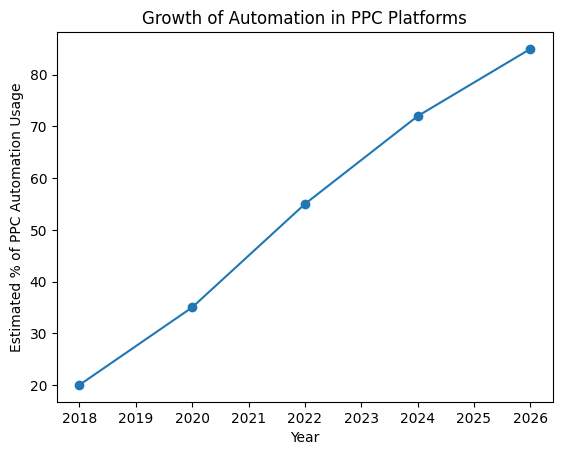
As automation removes repetitive tasks, PPC specialists are spending less time on operational work and more time on strategic thinking.
That means focusing on things like:
- Campaign structure and account architecture
- Feeding the right signals into algorithms
- Understanding how paid media supports broader business goals
In many ways, PPC is becoming less about “managing campaigns” and more about designing systems that allow algorithms to succeed.
Training the algorithm is the new optimization
One way I like to think about modern PPC is this:
We are no longer just campaign managers. We are algorithm trainers.
The performance of automated campaigns depends heavily on the inputs we provide:
- Conversion data.
- Audience signals.
- Creative assets (I can’t emphasize this enough).
- Campaign structure (still very important in 2026).
When these inputs are strong, the algorithm performs well.
When they are weak, even the best automation struggles.
So the real job today is not pressing buttons inside the platform.
It’s creating the right environment for the algorithm to learn.
My personal experience with AI in PPC
From my own experience working in digital advertising, this shift is already very real.
In our company, we developed -what we call- an internal DAG AI Hub that helps us automate many of the time-consuming tasks that used to take hours every week.
Things like reporting, data aggregation, and repetitive operational work are now handled automatically by this system.
The result is simple: we save a significant amount of time.
And instead of spending that time building reports or pulling spreadsheets, we can focus on the things that actually move performance:
- optimizing campaigns
- developing strategy
- testing new ideas
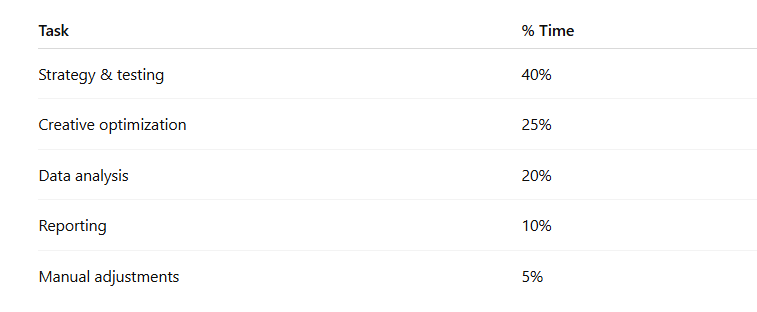
Automation hasn’t reduced our role. If anything, it has made strategy more important than ever. I decided to put this into numbers and the result is pretty clear after a couple of months: Strategy represents 40% of my time (see the figure below):
What skills PPC specialists need now?
As automation continues to evolve, the most valuable PPC specialists will be those who go beyond platform mechanics.
Some of the skills that are becoming increasingly important include:
- Strategic thinking
- Data interpretation
- Creative testing frameworks
- Understanding business objectives
The real value comes from understanding how marketing decisions impact business outcomes, especially in my industry: the automotive sector. Always changing especially after the numerous challenges we have to face from the new EU rules in this area (which is another interesting debate).
The future of PPC
Automation is not replacing PPC professionals.
What it is doing is pushing the role upward.
The future PPC specialist is not just someone who runs campaigns.
It’s someone who combines data, strategy, and creativity to guide the advertising systems.
In other words, the job is evolving from campaign operator to algorithm strategist. And honestly, that might make the role more interesting. We are no longer just campaign managers. We are algorithm trainers.