
One of the hardest conversations we have at What Matters Media is explaining why campaigns should not always launch immediately.
Most clients understandably want to move fast. They want ads live, data coming in, and results as quickly as possible. The issue is that modern PPC platforms are heavily reliant on conversion signals, and if the tracking setup is weak from the start, the algorithm learns from bad data.
That usually creates problems later when accounts begin to scale.
We recently started working with an app-based business where the ambition was clear: grow quickly, drive installs, and generate leads. What was less clear was the measurement setup behind it.
There was no MMP integrated, no GA4 setup, no GTM in place, and no clear agreement on what a valuable user actually looked like. Was success an install? A registration? A meaningful in-app action?
From the client’s perspective, the early focus on tracking probably felt like a delay. From our perspective, it was the groundwork that needed to happen before spending the budget responsibly.
This situation is not unusual. In fact, it is one of the most commercially important parts of modern PPC, especially now that platforms like Google Ads and Meta rely so heavily on automated bidding and machine learning.
The Temptation to Just Launch
Anyone can make a PPC account look successful in the first few weeks.
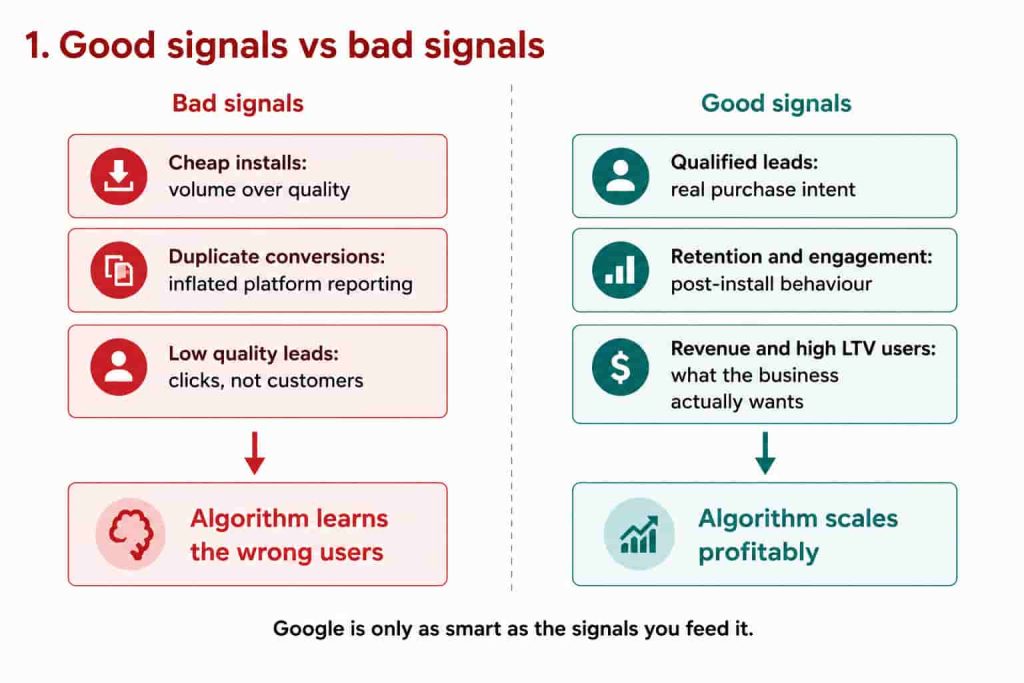
Buy cheap installs. Optimise towards clicks. Chase low CPAs on surface-level conversion actions. The dashboard looks great, the client feels reassured, and everything appears to be working. The problem comes later.
Modern PPC platforms, particularly Google and Meta, optimise aggressively towards whatever signal you feed them. If you tell Google to find more people who install an app, it will do exactly that.
The issue is that cheap installs are incredibly easy to buy. There is a huge pool of low-intent users who will download an app, never open it again, and disappear forever. Google is very good at finding those users if that is the outcome you optimise towards.
Once the algorithm has spent weeks learning from weak conversion signals, correcting course becomes difficult. At that point, you either reset learning entirely or accept a prolonged period of unstable performance while the platform relearns what success actually looks like.
Anyone can spend budget quickly. The harder part is building an account that still performs six months later.
Why Tracking Is Now Part of Campaign Strategy
There is still a common assumption that tracking is just a technical setup task. Something developers handle before marketers get involved.
That might have been true in 2015. It is not true anymore. Smart Bidding, AI Max, Performance Max, Demand Gen, and Meta Advantage+ are all heavily signal-driven systems. They learn from conversion data. They analyse who converts, what device they use, what content they engage with, what time they convert, and thousands of other behavioural patterns.
If your conversion data is duplicated, weak, or misattributed, the algorithm learns from bad information.
If you optimise towards installs when the real business goal is completed registrations, qualified leads, or revenue-generating actions, the platform will optimise for installs. Not outcomes.
This is not a small calibration issue. It changes:
- Who your ads reach
- What your CPAs look like
- Whether the account scales properly over time
Tracking is no longer just technical setup, it is part of campaign strategy.
But Tracking Can Also Be Overcomplicated
The industry also has a habit of pushing too far in the other direction.
Some agencies and consultants make it sound like businesses need enterprise-grade infrastructure before they can launch anything useful.
You do not need:
- A custom data warehouse
- Enterprise attribution software
- Perfect server-side tracking
- A full BI stack before spending on media
What you do need is:
- A clean GA4 implementation
- GTM configured properly
- Clear conversion actions tied to real business value
- Sensible attribution settings
- Agreed KPIs before launch
That setup is enough to scale intelligently and troubleshoot problems when they appear.
Perfect tracking does not exist. Useful tracking does.
Why Attribution Gets Messy So Quickly
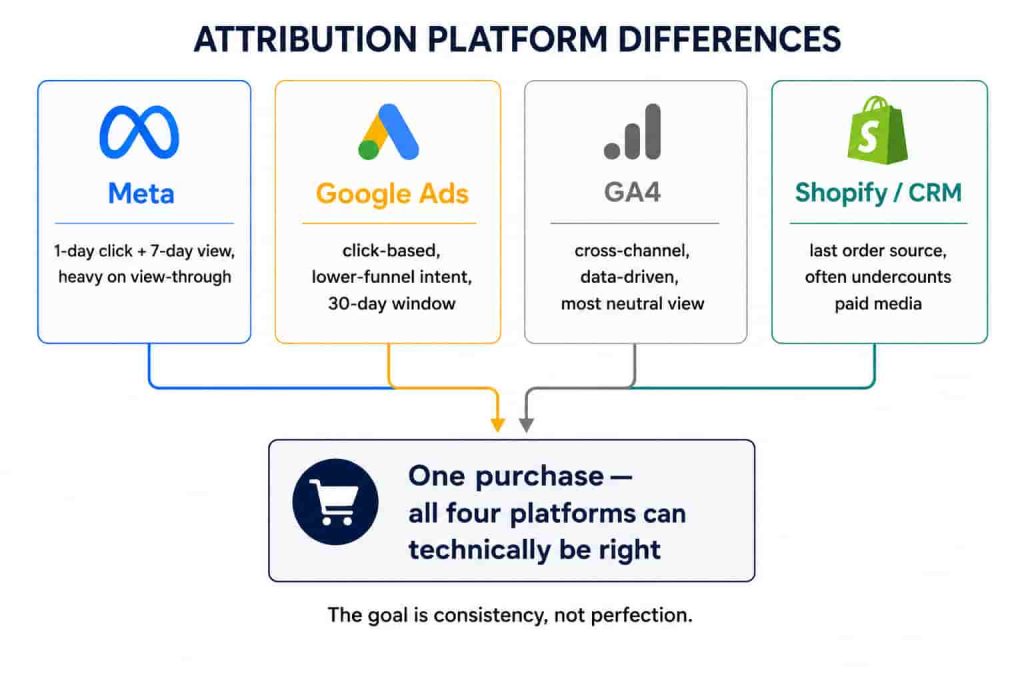
One of the most common frustrations clients run into is discovering that platform numbers never match.
Meta says it drove 40 purchases.
Google says 35.
GA4 says 28.
Shopify says 22.
Everyone claims success and nobody agrees, this is how modern attribution works.
Meta relies more heavily on view-through attribution, meaning it often claims conversions from users who simply saw an ad. Google Ads leans more heavily on click intent and lower-funnel behaviour. GA4 attempts to distribute credit across channels using a data-driven attribution model. Shopify and most CRMs usually focus on the final recorded source before purchase.
The result is that the same conversion can be claimed by multiple platforms simultaneously.
Without clear attribution rules, optimisation decisions become almost impossible.
GA4 is not perfect. No platform is fully accurate anymore due to iOS privacy changes, cookie deprecation, and increasingly fragmented customer journeys.
But having one consistent reporting framework is significantly better than trying to reconcile five competing dashboards every week.
Web Tracking vs App Tracking
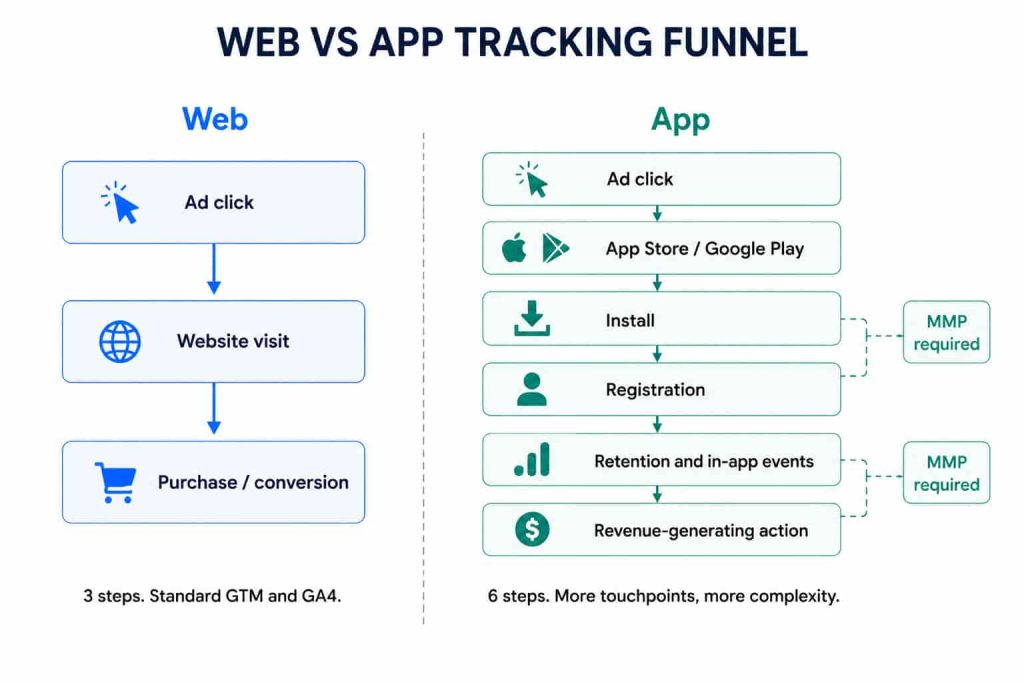
For most ecommerce websites, tracking is relatively straightforward:
Ad click → Landing page → Purchase → Conversion fires.
Apps are completely different.
The journey looks more like:
Ad click → App Store or Google Play → Install → App open → Registration → In-app action → Retention → Revenue event.
Every step introduces friction, and every step requires tracking.
This is where Mobile Measurement Partners (MMPs) like AppsFlyer or Adjust become necessary rather than optional.
Ad platforms cannot reliably track what users do inside apps after installation without a dedicated SDK feeding data back into the platform.
Without an MMP, you can measure installs. You cannot properly measure:
- Retention
- Downstream actions
- LTV
- Meaningful in-app engagement
And if you cannot measure those things, you cannot optimise towards them.
Cheap installs are easy to buy. Valuable app users are much harder.
For our client, this meant defining whether success meant:
- Installs
- Registrations
- Qualified leads
- Revenue-driving actions
before launching campaigns at scale.
That work is slower upfront, but it prevents months of optimisation towards the wrong outcome.
A Practical Starting Point
Every business will have different reporting requirements, but for most accounts I recommend:
Google Ads: 30-day click attribution window
Meta: 1-day click, 7-day view attribution
GA4: Use as your central reporting platform when comparing channel performance and discussing budget allocation.
For app campaigns, ensure your MMP is feeding post-install events back into ad platforms. Tracking installs alone is rarely enough if your goal is registrations, qualified leads or revenue.
The objective isn’t perfect attribution. It’s creating a consistent measurement framework that allows you to make confident optimisation decisions.
Final Thoughts
Modern PPC platforms are incredibly effective, but they’re only as good as the signals they’re given.
For our client, that meant investing time in measurement before launching campaigns. It wasn’t the fastest route to market, but it gives us a much better chance of optimising towards users who create real value for the business rather than simply generating cheap installs.
Tracking doesn’t need to be perfect before you advertise. It does need to be good enough to ensure the platforms are learning from the right outcomes.
That’s often the difference between campaigns that scale and campaigns that don’t.