When AI Max first launched, the PPC community split some skeptical & some cautiously optimistic. A year ago during Google Marketing Live, Google promised a smarter, more transparent alternative to Performance Max that lived inside your existing Search campaigns. Early benchmarks looked good on paper. And honestly? The pitch made sense.
But we’re past the pitch now. Months of real-world testing, independent research, and frankly some expensive lessons from me have filled in the picture. Here’s what you actually need to know now.
What AI Max is (quick overview)
Here’s a quick overview: AI Max is not a new campaign type. It’s a new optional add-on that offers three features you toggle on inside an existing Search campaign:
• Search Term Matching (broad match expansion plus keywordless targeting)
• Text Customization (AI-generated ad copy drawn from your landing pages and assets)
• Final URL Expansion (automated landing page selection)
Think of it as Google bringing Performance Max-style automation into Search without forcing you onto every placement across the network.
Your existing keywords still function as they always have. What changes is that Google’s AI now analyzes your landing pages and ad assets to match queries you never explicitly targeted.
What Google Claims vs. What Independent Data Shows
Google’s official benchmark is that advertisers who activate AI Max typically see 14% more conversions or conversion value at a similar CPA. For campaigns still relying heavily on exact and phrase match keywords, that number reportedly climbs to 27%.
No – Those figures are not fabricated. But they’re also not the full story.
Smarter Ecommerce (SMEC) analyzed more than 250 Search campaigns running AI Max and found a median revenue lift of 13% – which is close to Google’s claim. The catch is what came with it: a median CPA increase of 16%. Great – More revenue, but at a higher CPA. And the ROAS range across those campaigns stretched from 42% above baseline all the way down to 35% below. Only 22% of campaigns came anywhere close to their original ROAS targets. The other 78% either significantly over or underperformed.
And that is not a coin flip you want to take blindly.
A separate analysis by Brainlabs across 23 individual tests and 16 mature advertiser accounts found something equally important: campaigns that enabled all three AI Max features simultaneously saw a 40% higher success rate than those using only the baseline search term matching feature. Text customization alone improved weighted Quality Scores from 6.8 to 7.3, with ad relevance showing the most notable gain. The takeaway being, if you are going to test AI Max, going halfway in appears to produce the weakest results.
A real-world niche industry test: What happened when I ran it
In a niche B2B industry for lead gen, I ran AI Max on a Search campaign across a defined test window (Feb-Mar) and watched it closely. A short period due to the clients limited budget. Despite that, the results were a masterclass in what this feature actually optimizes for, and for us it was not conversions.
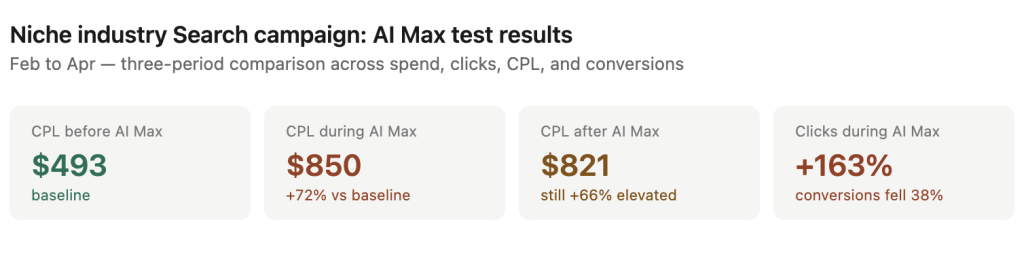
Before AI Max, the campaign operated like a precision instrument. Clicks were expensive at nearly $13 each, but that traffic was highly qualified. CPL sat at a healthy $493 (yes, I know – a lot for some industries, standard for ours though).
When AI Max was turned on, click volume nearly tripled and average CPC dropped 59%. On paper, that looks like a win. In reality, that was just vanity improvement because conversions fell 38% and CPL almost doubled to $850. The algorithm had successfully found cheaper clicks by moving up the funnel toward broader, lower-intent searches. More traffic, far fewer people who actually needed what was being sold.
Here is where it gets worse. After AI Max was turned off, spending actually accelerated. Clicks increased even further and CPC dropped to a new low of $4.62. It put the campaign in some sort of aftershock period. I was able to get the conversions to recover to 12, but CPA stubbornly stayed at $800+. The campaign had learned that cheap, high-volume traffic was acceptable, and it did not forget that lesson overnight.
As someone who is neuro-divergent, I’d like to paint the picture like a metaphor:
With AI-Max we basically hired an overly enthusiastic street promoter for a high-end, niche restaurant. He fills every seat in the house by handing out flyers at the mall. Suddenly we were packed with foot traffic.
The problem is that most of the crowd just wants the free bread & a glass of tap water. At the end of the night we sold less meals and it cost more money & energy to manage the chaos of the flood of traffic. After that month we fired the promoter, but the mall crowd keeps showing up because now your reservations system (campaign algorithm) learned that a packed house is the goal, not a profitable one.
The algorithmic hangover is real. Turning AI Max off does not automatically reset your campaign’s learned behavior. It still needs to go through a shedding phase and you may need to rebuild negative keyword lists, tighten match types, and give Smart Bidding time to relearn what a real conversion looks like for your account.
The best part of the experience was our Google Rep, reviewing this data and recommending we spend another $10k on a different campaign and try again.
What the SMEC data revealed about query expansion
According to SMEC’s research on over a million AI Max impressions, the majority of AI Max expansion was coming from Exact Match keywords, not Broad Match as many assumed. The distribution was roughly 80% Exact Match, 20% Phrase Match, and less than 1% Broad Match.
What that means practically: AI Max is often taking a tightly defined keyword and broadening the query net around it. If your search term monitoring is not active, you will start matching against queries that were never part of your original strategy and you likely will not notice until your CPA has already moved.
The same research also found that in some accounts, AI Max overlapped with Broad Match queries at rates of 49% to 63%, often traced back to legacy Broad Match Modified keywords that were never properly cleaned up after Google migrated them to Broad Match years ago. Messy keyword structure going in means messy query expansion coming out.
The research also flagged competitor term hijacking as a real risk. In one documented account, AI Max scaled so aggressively into competitor brand terms that it consumed 69% of total Search impressions. That is not reach. That is wasted spend with no real strategic intent behind it.
The DSA news you cannot ignore
In a conversation with SMEC’s Mike Ryan, Google Ads Liaison Ginny Marvin confirmed that Google plans to deprecate Dynamic Search Ads and absorb the technology into AI Max for Search. No firm timeline has been given, but if Google’s history with campaign migrations is any indicator, the runway from announcement to sunset is roughly a year.
If you are currently running DSA campaigns, now is the time to start testing AI Max’s keywordless features in your existing Search campaigns so the transition is strategic rather than forced. Migrating DSA traffic into Performance Max instead is not the recommended path.
Before you turn it on: A new & updated practical checklist
AI Max rewards preparation. Going in without the right foundation is the fastest way to end up with inflated traffic and a broken CPA.
First, get your conversion hygiene in order. Sloppy tracking going into an AI-driven feature means the algorithm is learning from bad signals. Enhanced Conversions are worth setting up before you flip the switch.
Second, make sure your campaign is not budget-constrained. Expanding query targeting while limiting budget is contradictory. Either give the campaign room to breathe or tighten your bid strategy targets so it can work within real boundaries.
Third, run all three features together. The Brainlabs data is pretty clear that partial adoption produces the weakest results. Text customization and URL expansion both carry risk, but they also carry the upside for some industries.
Fourth, audit your keyword structure before you start. Legacy Broad Match Modified keywords left uncleaned will create overlap and attribution confusion. Start clean.
Fifth, evaluate performance at the account level, not the campaign level. Campaign-level CPA by match type is not the right lens. AI Max can shift traffic between campaigns within an account, and what looks like a loss at one level may show a different story at the account level.
Sixth, check whether you are running DSA and Performance Max alongside it. Nearly 50% of accounts in SMEC’s dataset were running all three simultaneously, creating redundancy and making it harder for bidding models to learn effectively.
Seventh, watch your Search Partner Network if you use it. One account in the SMEC data saw half a million monthly impressions on the Search Partner Network at a 0.07% conversion rate versus 3% on standard Google Search. That is a setup where your budget bleeds out quietly. Segment it and evaluate it separately.
Eighth, reconsider other alternatives if you’re choosing AI Max for niche industries in lead gen. As AI Max starts to function more top of the funnel and lose sight of the intended goal which is the SQL.
The bottom line
AI Max may not be worth all of the hype, but it is definitely not a scam. It can absolutely function as a real expansion tool that delivers real volume. What it is not, at least not consistently, is an efficiency improvement. Independent research now confirms what many of us experienced firsthand: more conversions are possible, but they come at a higher cost per acquisition, and the range of outcomes across accounts is wide enough that there is no safe assumption about which direction yours will go.
The advertisers seeing the best results are treating AI Max like a controlled expansion layer, not a replacement for the foundation they already built. They are going in with clean accounts, strong conversion data, active search term monitoring, and a clear picture of what success looks like at the account level before they flip the switch.
If your account is already heavily reliant on Broad Match, DSA, and Performance Max simultaneously, the incremental benefit is likely the lowest. If you are running a tight, well-structured Search campaign with room to grow, the upside is real. Just go in knowing what the machine is actually optimizing for, because it will succeed wildly at that goal whether or not it is the goal you had in mind.