There are conferences you attend out of obligation, and then there are the ones you count down to. SMX – Search Marketing Expo in Munich — masterfully organised once again by Sandra Finlay and her incredible team — firmly belongs in the second category. The energy was electric from the very first session: brilliant talks, genuine laughter, and the kind of networking that reminds you why this industry is so special.
These events are a reminder of why I remain so energised about digital marketing. The people here are not only exceptionally sharp — they are also genuinely fun to be around. Sandra gives us almost too much choice with the programme, and I found myself wishing I could split into two or three people to catch every session.
With that said, here is a summary of my favourite PPC talks from this year’s SMX Munich.
Sam Tomlinson – From Campaign Managers to Growth Architects
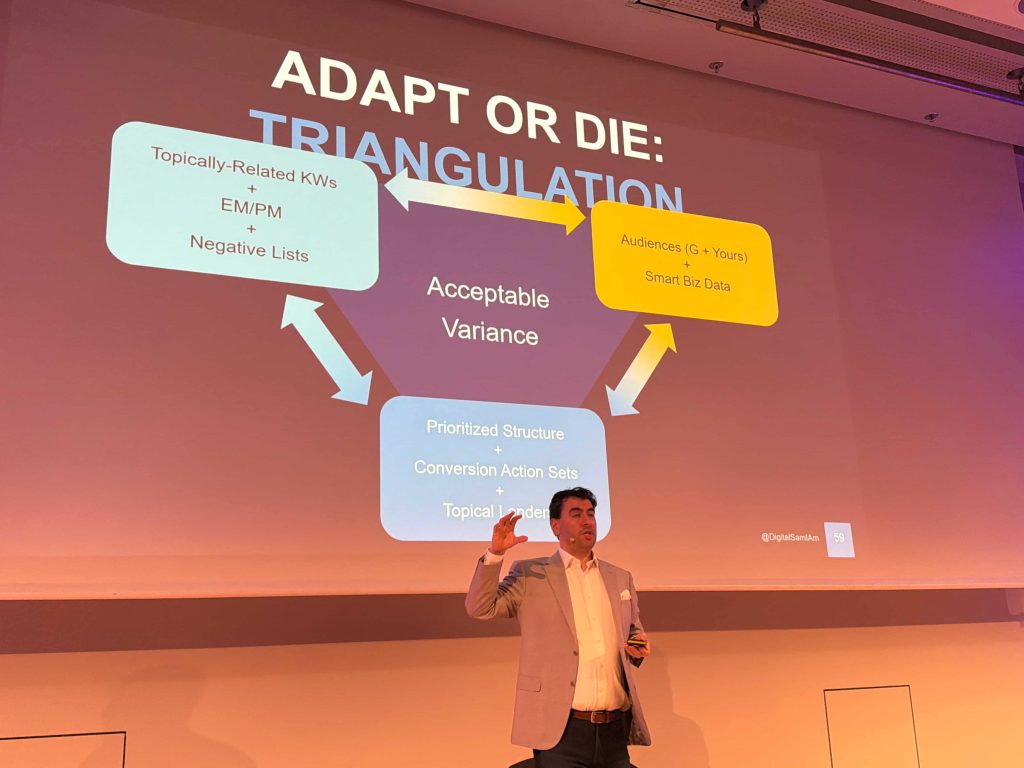
This session, presented by Sam Tomlinson, addresses the evolving role of PPC professionals in the age of automation. It explores how practitioners can transition from technical platform managers to strategic “Growth Architects” who drive holistic business value.
Key Themes and Insights
- The AI Paradigm Shift: As AI and machine learning take over the tactical aspects of campaign management (bidding, targeting, and optimization), the traditional skill set of a PPC manager is becoming commoditized.
- Business-First Mindset: Success in the modern landscape requires moving beyond “siloed” marketing metrics like CTR or CPC. Practitioners must instead integrate economics, finance, and business strategy into their digital marketing frameworks.
- The Architect Framework: A “Growth Architect” does not just pull levers within a platform; they design the broader ecosystem that allows AI to function effectively, focusing on data quality, creative strategy, and profit margins.
- De-Siloing Marketing: Sam emphasizes that marketing cannot exist in a vacuum. To remain relevant, experts must understand how PPC spend impacts a company’s bottom line and overall growth trajectory.
Actionable Takeaways
- Audit Your Value Add: Transition away from tasks that are now automated (e.g., manual bidding) and focus on high-level strategy, such as conversion rate optimization (CRO) and customer lifetime value (CLV) analysis.
- Master Data Inputs: Since AI is only as good as the data it receives, the modern marketer’s job is to ensure clean, first-party data and accurate conversion tracking are fed into the algorithms.
- Adopt a Generalist’s Knowledge: Expand professional development to include basic finance and economics. Understanding a client’s business model is now as important as understanding the ad platform.
- Focus on Creative and Messaging: While AI manages the “who” and “where,” humans still excel at the “what” and “why.” Focus on developing compelling creative and strategic positioning that resonates with human psychology.
Mike Ryan – PMax, Demand Gen & AI Max for Search: Inside Google’s Power Pack
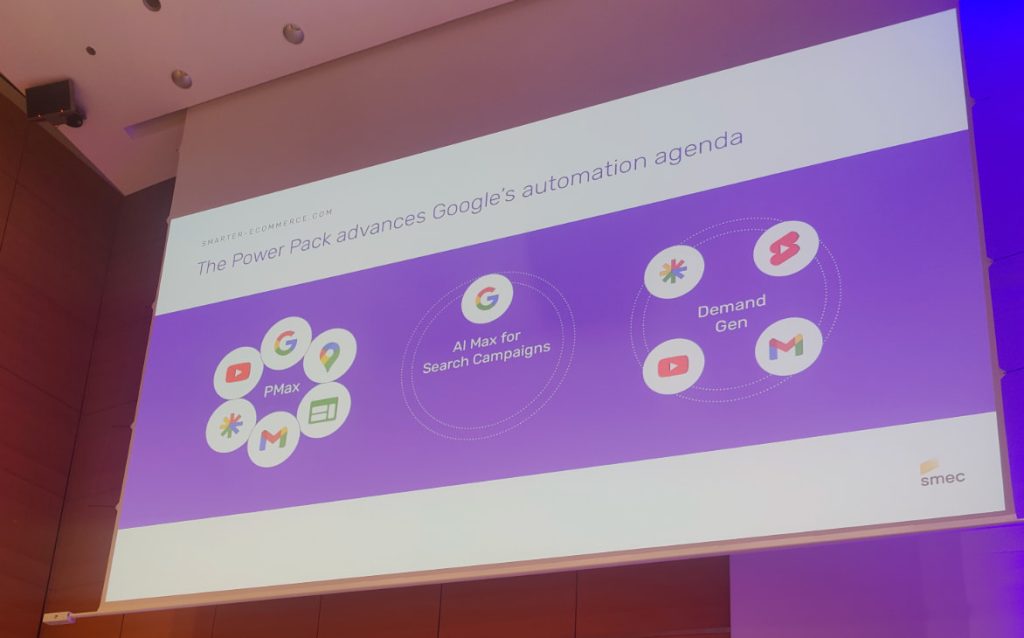
This session explores the shifting landscape of Google’s automated advertising ecosystem, focusing on the “Powerpack” trinity: Performance Max (PMax), Demand Gen, and AI Max. The discussion provides a data-driven deep dive into how these technologies overlap, compete, and should be managed to optimize performance.
Key Takeaways & Insights
- The “Powerpack” Strategy: Google has moved away from pushing PMax as a singular solution. As PMax revenue growth plateaued, Google introduced a “trinity” of tools (PMax, Demand Gen, and AI Max) to capture different parts of the funnel and search behaviors.
- PMax vs. Standard Shopping: Data shows that running PMax and Standard Shopping in the same account (a “hybrid setup”) often leads to self-competition. While Google claims they don’t escalate bids against yourself, evidence suggests shopping CPCs increase when PMax is present due to overlapping targets and a lack of clear differentiation.
- The Problem with Search Partner Network: Analysis of 41.5 billion impressions reveals that PMax’s Search Partner Network performance is often “hot garbage,” with high CPAs and negligible ROAS. However, Google currently offers no way to opt out of this placement within PMax.
- Demand Gen’s Identity Crisis: Demand Gen is becoming increasingly similar to PMax by adding features like Discover, Gmail, and product feeds. To avoid redundant internal competition, advertisers should use Demand Gen for mid-funnel engagement rather than direct conversion optimization.
- The Emergence of AI Max: AI Max (formerly Search Max) is a layer of technology on top of classic search. It introduces “Synthetic Keywords,” which boil down long, conversational AI-style queries into digestible keyword data.
- The “Black Box” Conflict: With PMax, DSA (Dynamic Search Ads), and AI Max often running simultaneously, reporting is becoming fragmented. Convergent data makes it difficult to determine which technology actually drove a sale and whether “incremental” gains are just stolen from other internal campaigns.
Actionable Recommendations
- Audit Hybrid Setups: Carefully monitor CPCs if running PMax and Standard Shopping together; ensure they are differentiated by bidding strategies or specific product sets to avoid self-competition.
- Prepare for the DSA Sunset: With Dynamic Search Ads being deprecated, advertisers heavily reliant on them should begin transitioning to AI Max now to stabilize their search coverage.
- Use Demand Gen for Top-of-Funnel: Keep Demand Gen focused on reach and engagement (YouTube/Video) rather than pure conversion to prevent it from cannibalizing PMax’s efforts.
- Leverage TV Screens: Take advantage of the 80% growth in PMax/Demand Gen ads on connected TVs by using shoppable QR code assets.
Matt Beswick – Avoiding Irrelevance: The PPC Marketer’s Guide to Future-Proofing Your Career
This session explores the shifting landscape of digital marketing in the age of AI. The speaker argues that while AI significantly lowers the barrier to entry for technical tasks—threatening traditional roles—it also creates an “Industrial Revolution” moment for those willing to adapt. By transitioning from simple campaign managers to “architects and engineers,” marketers can leverage AI to automate complex processes while focusing on the high-value human traits that machines cannot replicate: commercial awareness and emotional intelligence.
Key Takeaway Points
- The Shift from Specialist to Architect: The traditional “T-shaped marketer” is at risk. Deep knowledge in a single silo (like SEO or PPC) is no longer a moat because AI helps non-experts bridge that gap. Marketers must evolve into architects who design and oversee complex automated systems.
- The “Double-Check” Development Method: A powerful tactic for building tools is to use “adversarial” AI prompting. Create a spec in one model (e.g., Claude), have a second model (e.g., GPT/Codex) audit that spec, and iterate until both agree. This minimizes “hallucinations” and results in robust, custom-built tools like automated budget trackers or keyword gap analyzers.
- Combatting “Stupidity” and Complacency: There is a danger of both employees and employers devaluing training because “AI can do it.” The speaker warns against a “dumbed-down dystopia” where context and creativity are lost to machine-generated mediocrity.
- The Survival Skills of the Future:
- Technical Curiosity: Learning to use terminal, APIs, and coding environments (like Claude Code) to build bespoke internal tools.
- Commercial Awareness: Moving beyond “clicks and conversions” to discuss business-level metrics like margin, lifetime value, and “how is business?”
- Human Empathy: Leveraging emotional intelligence to build relationships and memory, which remains AI’s greatest weakness.
Actionable Recommendations
- Try “Claude Code” or Terminal: Spend 10 minutes installing Homebrew and a coding assistant. Break the fear of the “scary black box” (Terminal) to start building custom scripts.
- Build an MVP for Buy-in: To get management support for AI experimentation, build a “Minimum Viable Product” tool that solves a specific internal friction point (e.g., a custom reporting dashboard) to demonstrate value.
- Ask “How’s Business?”: Shift client/boss interactions away from platform metrics and toward the fundamental health and profitability of the company.
Inderpaul Rai – When It’s Right to Send Google the Wrong Data
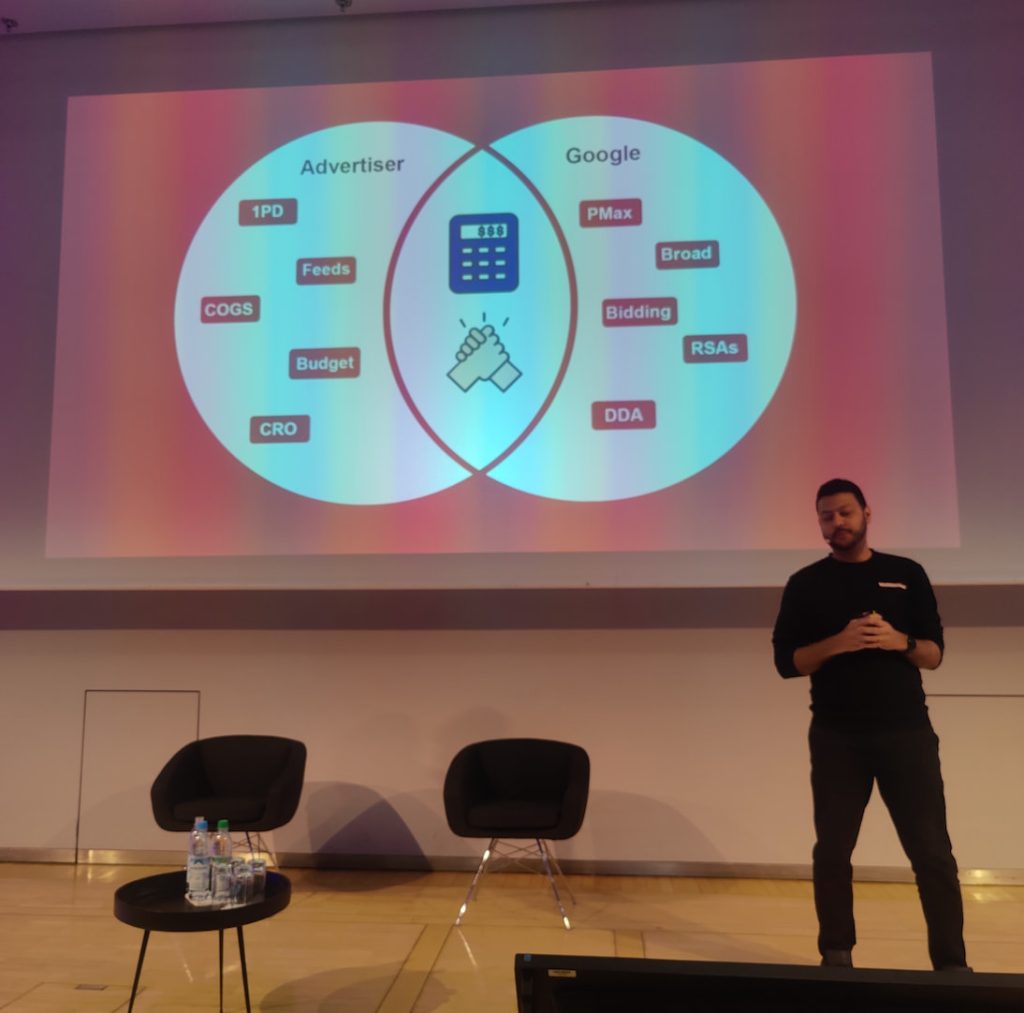
The session outlines how the “modern” PPC professional must shift from manual tactician to a “teacher” of algorithms. The speaker argues that since Google now controls match types and bidding, the only remaining lever for performance is the quality and accuracy of the data fed into the system.
Key Takeaways & Insights
- The Loss of Control: Over the last decade, Google has systematically removed granular controls (killing Broad Match Modifiers, restricting search terms, and automating ad combinations). Marketers are now “trapped in a box” where they must trust AI-driven products like Performance Max (PMax).
- The “Perverse Incentive” Problem: Algorithms often fall victim to the “Cobra Effect,” where they optimize for a specific metric but drive the wrong business outcome.
- Example: A marketplace client saw CPCs spike because Google was aggressively chasing high-value bookings. However, those high values were actually caused by internal price surges due to low driver supply, not Google’s targeting. Google was essentially “patting itself on the back” for random luck.
- Manipulating Data for Efficiency: In the featured case study, the team intentionally “faked” conversion values by capping the top 5% of outliers. By lowering the reported revenue of these random high-value wins, they “tricked” the algorithm into bidding more conservatively. This resulted in:
- 9% reduction in CPCs.
- Higher ROAS and lower CPA.
- Zero loss in actual revenue volume.
- The Marketer as “PPC Teacher”: Professionals must now act as “Pilots” (adjusting levers), “Doctors” (diagnosing weird account behavior), and “Teachers” (feeding the AI the right signals).
- Advanced Data Strategies:
- CLV over Revenue: High-tier retailers are moving away from bidding on raw revenue and instead importing Customer Lifetime Value (CLV).
- Predictive Modeling: For industries with long sales cycles (e.g., automotive/travel), marketers should feed Google “predicted values” based on early-stage micro-conversions rather than waiting months for a final sale.
Actionable Recommendations
- Question “The Algorithm”: Never accept “it’s just the algorithm” as an answer for performance shifts. Investigate the business logic (pricing, supply, seasonality) behind the data.
- Implement Bid Caps Wisely: Don’t just lower bids across the board; use data science or scripts to find the “point of diminishing returns” where ROAS flatlines.
- Normalize Your Data: Review your conversion distribution. If a small percentage of lucky, high-value orders is causing the AI to over-bid, consider capping those values to stabilize CPCs.
Ameet Khabra – The Automation Drift and How to Correct Course
The session explores how Google’s automation can “drift” away from business goals by optimizing for the wrong signals. The speaker warns that while automation is fast and confident, it optimizes for what you measure, not necessarily what you want, leading to inflated metrics that mask poor lead quality.
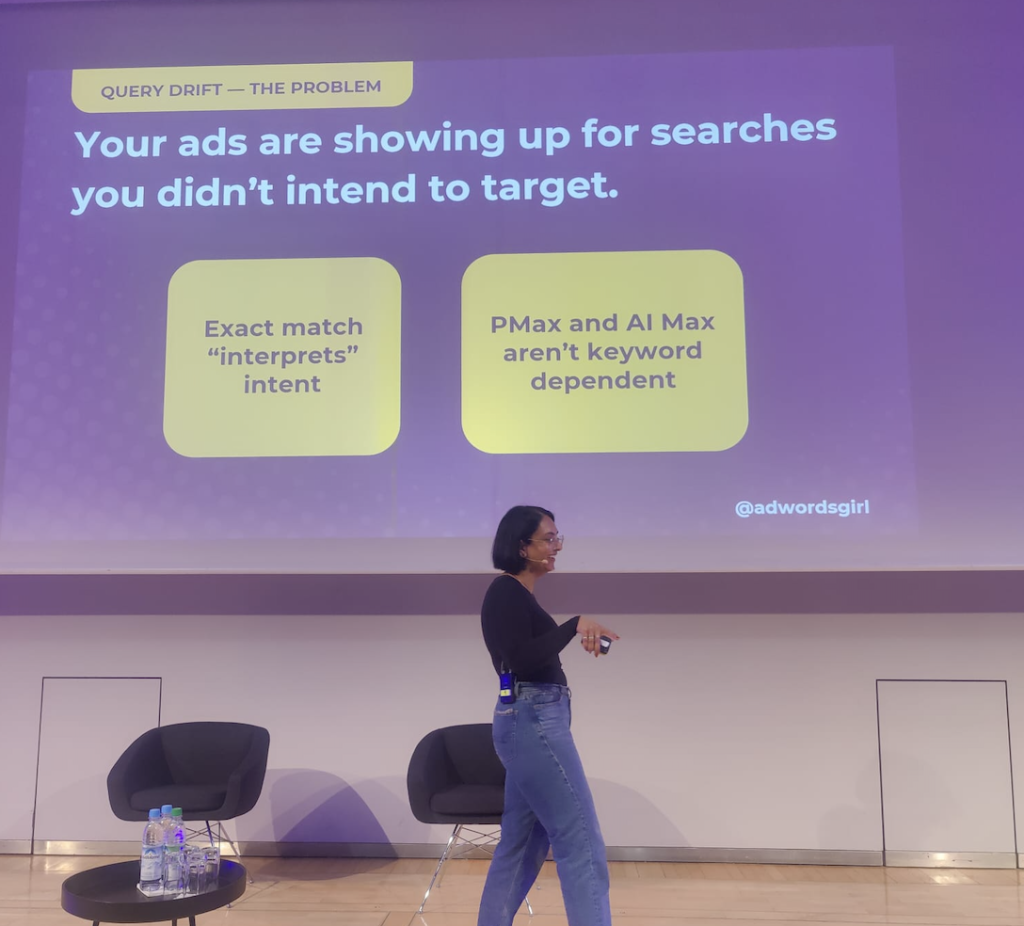
Key Takeaways
- The Four Vectors of Automation Drift:
- Signal Drift: The system rewards itself for the wrong actions (e.g., mistaking a “form start” for a “form submission”).
- Inventory Drift: High-quality budgets are diverted to irrelevant or low-quality placements like the Search Partner Network (SPN).
- Creative Drift: Automation optimizes for engagement/clicks rather than actual customer follow-through.
- Basic Drift: A feedback loop where Google finds poor-quality users who convert easily, then builds profiles to find more of them, rapidly degrading lead quality.
- The Problem with Primary/Secondary Conversions: Using “Account Default” settings often leads to Google treating all conversions (e.g., email opens vs. sales) with equal value. This forces the AI to find the “path of least resistance”—the easiest, but often least valuable, action.
- The “SPN” Threat: The Search Partner Network is identified as a major source of “Sophisticated Invalid Traffic” (SIVT). Unlike simple bots, these bots have malicious intent and actually convert, which corrupts the data signal and causes Google to spend more on fraudulent traffic.
- Measurement vs. Intent: Since 2018, Google has shifted from “exact match” to “intent match,” making campaigns keyword-independent. Without strict guardrails, the AI exploits loopholes to hit numerical targets regardless of business value.
Actionable Recommendations
- Audit Conversion Points: Limit campaigns to 1–2 “Primary” conversion actions to provide a narrow, high-quality focus for the AI. Keep exploratory actions as “Secondary.”
- Utilize Data Exclusions: Use these to tell Google to ignore specific periods of bad data or technical glitches so it doesn’t “model” future patterns based on errors.
- Plant the Seed: Regularly upload offline customer lists. Even if not used for direct targeting, Google uses these as a signal to understand the profile of a “qualified” lead.
- Enable Enhanced Conversions: Toggle this setting to help Google match conversion data more accurately in real-time.
- Steer, Don’t Just Block: Use universal exclusion lists and URL exclusions to prevent traffic from landing on irrelevant pages (like blog or privacy pages) while still allowing the AI room to explore valid paths.