If you manage Search campaigns, AI Max is no longer an option now that I’ll test it someday. Starting in February 2027, Google will automatically upgrade campaigns that use Dynamic Search Ads, automatically created assets, or campaign-level broad match straight into AI Max. Translation: a lot of us are getting it switched on whether we asked for it or not.
And here’s somethig that makes me twitch slightly. Google’s headline number is a tidy ~7% lift in conversions or conversion value at a similar CPA when you run the full feature suite and that sounds lovely. But that’s the average across the full suite versus search term matching alone, not “switch it on and watch your account roaring.” Independent testing tells a different story: a big chunk of advertisers see neutral or even negative results once they flip everything on.
So who’s right? Both, sort of. AI Max genuinely helps in some accounts and quietly leaks budget in others, and the difference almost always comes down to what you switch on and what you fence off.
This is the no-hype version: what AI Max for Search actually is, the features pulling their weight, the ones bleeding spend, and a pre-upgrade checklist so February doesn’t catch you out.
First, what AI Max for Search actually is
Quick, because you’ve got campaigns to run.
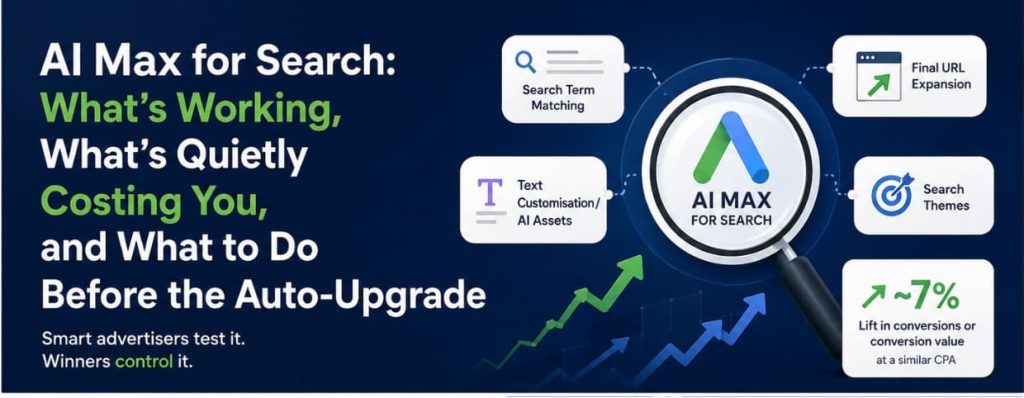
AI Max isn’t a new campaign type. It’s a suite of AI features that sits on top of your existing Search campaigns and broadens how they reach and respond to queries. The main parts invlove:
- Search term matching: It expands the queries your ads can show for, beyond your provided keyword list.
- Final URL expansion: It lets Google send traffic to a page on your site that it reckons the best match to the query.
- Text customisation / AI-generated assets: Google writes headlines and copy variations based on the guidelines and theme.
- Search Themes: You give Google topic signals to guide where it looks for demand.
It’s out of beta in 2026 and available globally in each account. This is reason exactly why it’s worth getting your attention around now, rather than after the upgrade happens.
The numbers everyone’s quoting (and why they mislead)
We see many people post screenshot of AI Max success and you set the bar so high that you get scared to start with. So here are some reality check before you benchmark yourself against a screenshot someone posted on LinkedIn:
- Google’s own framing is a ~7% lift, full suite vs search term matching alone.
- You’ll also see a 263% case study doing the rounds. Ignore it. That’s a cherry-picked best case, not your random account.
- Independent analysis suggests a ~10% improvement already puts you ahead of most advertisers running it, because a large share report neutral or negative results.
So set the bar on real facts. If AI Max gives you a real, measurable single-digit lift without compromising on your lead quality, that’s a real win for you. Anyone promising you triple digits is a red flag.
What’s actually working
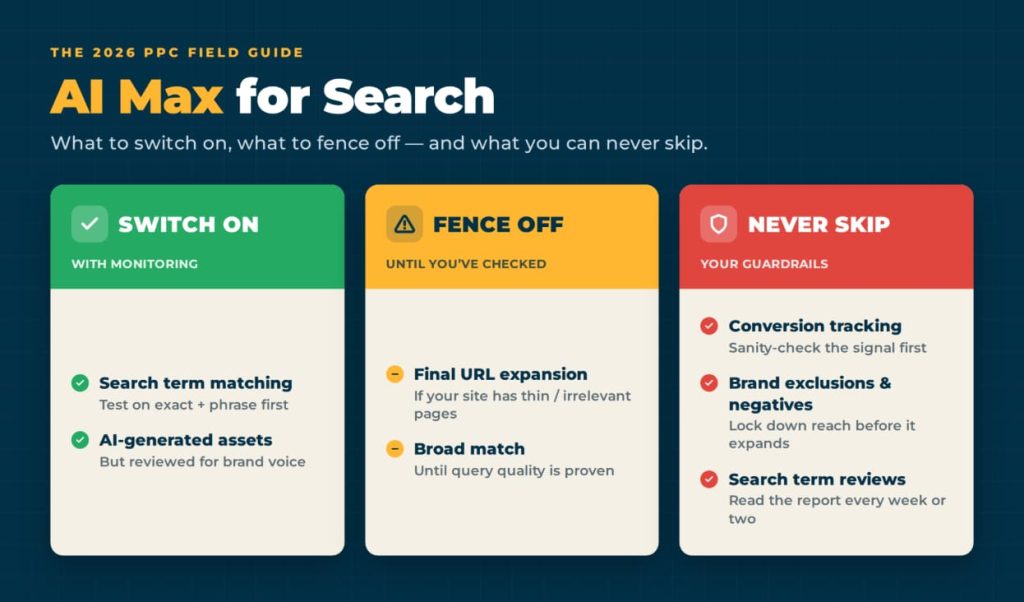
So, here is the the good news that works in all accounts. Some of the AI Max retain their performance, especially if your accounts have solid foundations.
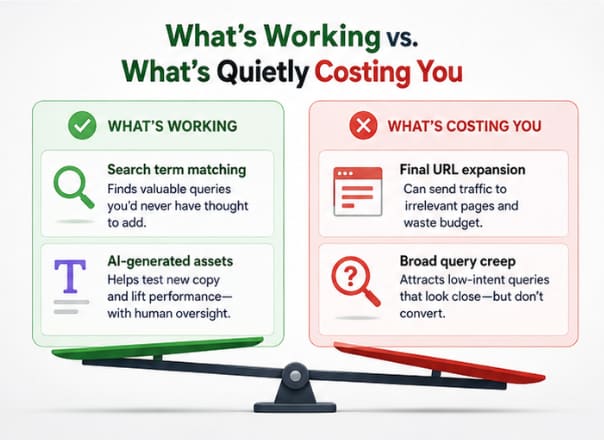
Search term matching, when your keywords are tight
If your keywords list is already refined and you have sort after Negative Keywords list, search term matching can identify valuable queries you’d never have thought to add yourself. The practical way is to test it on Exact and Phrase match and you will have a quality traffic and after stablize results, you can add the broad match in the system.
AI-generated assets, with a hand on the wheel
The text customization genuinely helps you to test new ad copy and lift the tried ad copy. But here is something to notice: Ad copy quality varies and you have to keep an eye on these assets if they meet the Brand specific voice or compliance with Google. We have to monitor each headline and description if it meets our standard.
What’s quietly costing you
Now we talk about the flip side of it.
Final URL expansion is sending traffic to the wrong page
This is something that need critical control. URL expansion sends traffic to those pages of your website that has nothing to do with your ads. Like your blog post page, contact us, home page and other just like them. And in this case it just kill your budget while you are hoping to get leads or sales.
Broad query creep
If you dont supervise your search term matching and eventually you wil find your ads showing for the queries that are close to your intent but actually they aren’t. They eat up ad spend fast and you hope for conversions inside “more conversions” until you sit down and read your search term report properly.
Your pre-upgrade checklist (do this before February)
If you do nothing else, do these.
- Sanity-check your conversion tracking. AI Max heavily depends on whatever you tell it is a conversion. So if you give it a weak signal, you will not be getting desired results.
- Lock down brand safety. This is guardrail on your ad budget. Negative Keywords list, brand exclusions, and any other thing that prevent your accout to leak the budget
- Decide on URL expansion deliberately. If your site has many irrelevant pages, fence it off now. It is better than discovering where your budget went later.
- Set up a one-click experiment. Don’t upgrade it on hypothetically. Test run it first so you can actually see the incrementality.
- Read the AI-generated assets. Always check and approve your AI assets. They must match your brand voice and Google compliance.
How to know if it’s actually working
If your conversion went up then it is not something that “AI Max make me money”. There are some honest checks:
- Use experiments, not vibes. A proper test tells us clearly whether AI Max is incremental or just claiming credit for conversions you’d have won anyway.
- Watch query quality. Your search term report will tell you within a week or two whether reach expansion is finding gold or junk.
- Judge CPA/ROAS at a similar volume. More conversions at a higher CPA is not actual growth. it’s a leak dressed up as growth.
The bottom line
Automation doesn’t mean that you have dust off your hands. That’s the whole game with AI Max.
As I always say that the advertisers who win in 2026 wont be the ones who refused automation or the ones who flipped every toggle and forget. But they will be one who use it like a power tool with solid supervision and put an eagle eye to every assets that Google presents to their audiences.
The upgrade is coming either way. Walking in with a checklist beats getting upgraded by surprise.